Command & conn.
Where the CO, OOD, and quartermaster of the watch fight the ship. Every helm order, every course change, every maneuvering board is worked here.
Heritage tie The oldest role at sea — unchanged since sail.
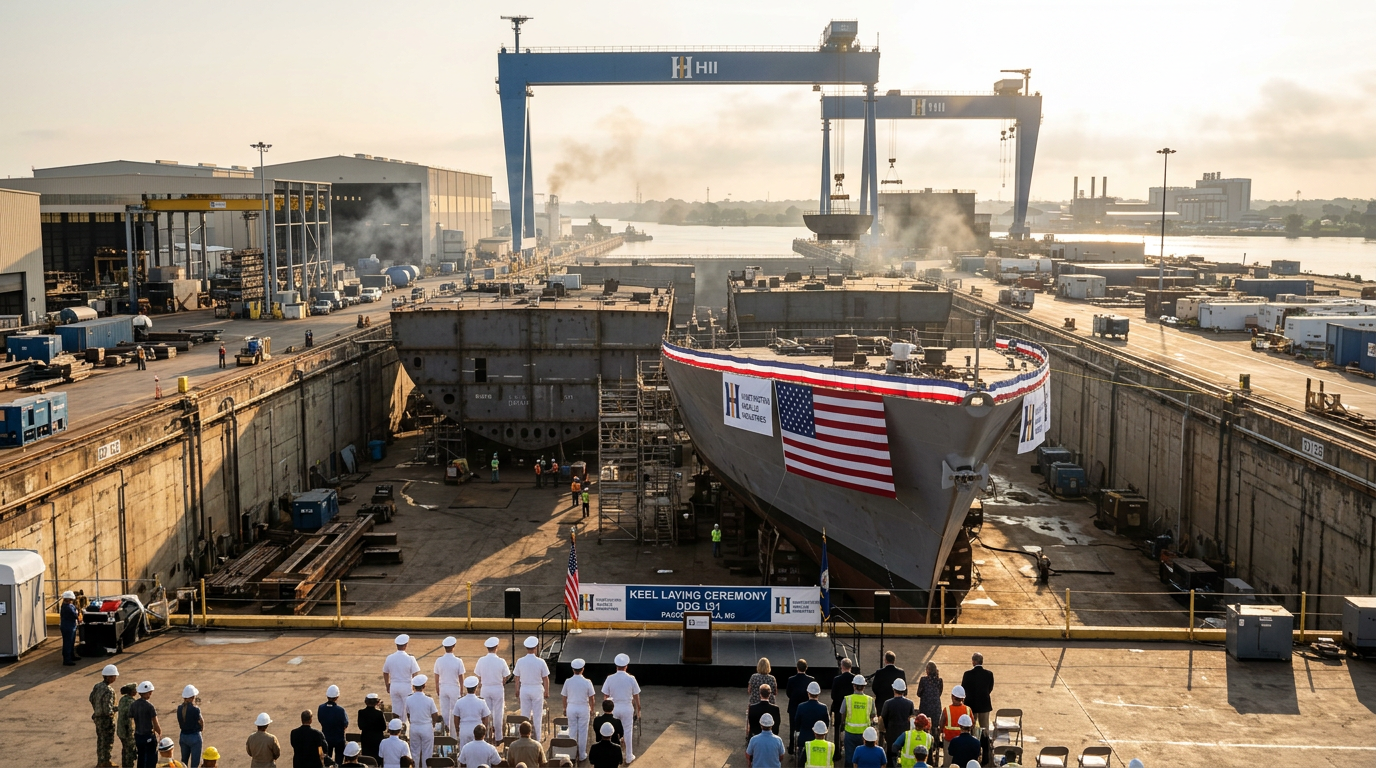
Under contract at Huntington Ingalls Industries, Pascagoula, Mississippi. She will be the 89th destroyer of the Arleigh Burke class. Fabrication is tentatively anticipated to begin in the first quarter of 2027. No fleet assignment has been announced.
Hover a station on the profile below to see what it does today and how it echoes the fireroom watch Fireman Trinidad stood in 1915.
Where the CO, OOD, and quartermaster of the watch fight the ship. Every helm order, every course change, every maneuvering board is worked here.
Air and Missile Defense Radar — four fixed arrays that see farther and discriminate more targets than any surface radar the Navy has ever fielded.
Standard Missile, ESSM, Tomahawk, ASROC — a mixed load-out of interceptors and strike weapons launched vertically from the forward and aft decks.
A five-inch gun forward, used for surface engagement, naval gunfire support, and the traditional gun salutes rendered on ceremonial occasions.
Anti-submarine warfare, over-the-horizon targeting, search-and-rescue, and vertical replenishment. The destroyer's reach doubles with helos embarked.
Four LM2500 gas turbines instead of boilers. The men and women who stand this watch keep a ship alive — the same job Fireman 2nd Class Trinidad stood the day his boiler burst.
SPY-6 AMDR paired with the Aegis Baseline 10 combat system delivers integrated air, cruise, and ballistic missile defense at fleet scale.
SQQ-89 sonar suite, MH-60R Seahawk operations, and torpedo defense — the destroyer's core underwater warfare role.
Naval Strike Missile, 5-inch/62-caliber gun, and CIWS provide layered engagement from the horizon in.
Tomahawk Block V from 96 Mk 41 VLS cells — the fleet's premier land-attack strike capability at range.
Cooperative Engagement Capability and Naval Integrated Fire Control-Counter Air let her fight as one node in a larger fleet-wide sensor grid.
Deployable across the Indo-Pacific for typhoon response, medical support, and partner-nation cooperation — a persistent U.S. Navy presence.
Committee-approved video references — Flight III capability and the Surface Navy Association's tribute to Fireman Second Class Trinidad.
USS San Diego (ACR-6) began life as the armored cruiser California, commissioned in 1907 and renamed in 1914 to free her first name for a battleship. As flagship of the Pacific Fleet she flew a rear admiral's flag — and in her No. 2 fireroom, on a January morning in 1915, a 24-year-old Filipino fireman earned the Medal of Honor.
She survived her boilers. Repaired at Mare Island, she returned to the flagship's berth, and when America entered the Great War she escorted convoy after convoy through the most dangerous miles of the Atlantic crossing — and delivered every one of them safely.
Two Medals of Honor were earned in her firerooms that January day: Trinidad's, and Ensign Robert W. Cary Jr.'s — who held the power-closing watertight doors open with his own body so the men trapped inside could escape.
On 19 July 1918, northeast of the Fire Island lightship, she struck a mine laid by the German submarine U-156. She capsized and sank in twenty-eight minutes; six of her crew were lost. She was the only major United States warship lost in the First World War. Her wreck — a protected war grave in some 110 feet of water off Fire Island — rests today on the National Register of Historic Places.
A century later, the Navy gives the story back its name. Not the cruiser's name. The fireman's.
In Navy tradition, a ship's sponsors are her lifelong patrons — they christen her, and they stand as godmothers to her crew for as long as she sails. Secretary Del Toro presented DDG-139's sponsors on 10 January 2023, at the Rayburn House Office Building in Washington.
The namesake's great-granddaughter — carrying her family's name to the bow of the first U.S. Navy warship ever named for a Filipino.
The first Filipino American admiral in U.S. Navy history — and the first military woman in American history appointed White House Physician.
The Secretary of the Navy announces that DDG-139 will bear the name of the only Filipino in the U.S. Navy to receive the Medal of Honor.
Secretary Del Toro presents the ship's sponsors in Washington: Christine Trinidad, the namesake's great-granddaughter, and Rear Admiral Connie Mariano, USN (Ret.), the first Filipino American admiral in U.S. Navy history.
Ingalls Shipbuilding's distributed shipbuilding network is at work on DDG-139's structural units — 37 units planned across the partner yards, phased into construction at Pascagoula (HII, 2026).
Fabrication is tentatively anticipated to begin at Huntington Ingalls Industries, Pascagoula, Mississippi — the next milestone toward keel laying.
Formal keel-laying — the ship's sponsors authenticate the keel with their initials welded onto a hull plate. Projected in the committee's published outlook.
The ship's sponsors break the champagne bottle across the bow; the hull enters the water. Projected in the committee's published outlook.
USS Telesforo Trinidad is placed in commission and joins the U.S. Navy's operating forces. Projected in the committee's published outlook.
A destroyer is a warship. But every ship also carries a name — and every name carries a story.Commissioning Committee Charter